

2026 Hyundai Santa Fe vs 2026 Honda Pilot: Why Santa Fe Is the Better Family SUV in Ontario
2026 Hyundai Santa Fe vs 2026 Honda Pilot: Why Santa Fe Is the Better Family SUV in Ontario
Posted on August 14, 2026
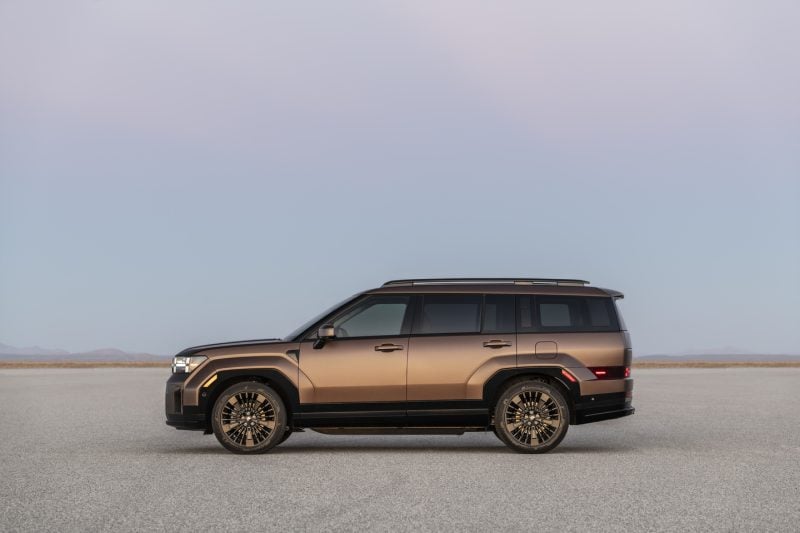
Shopping for a three-row SUV in Ontario often comes down to two very different approaches to the same job. The 2026 Hyundai Santa Fe leans on a hybrid powertrain and a tighter footprint, while the Honda Pilot sticks with a larger V6 and more interior volume. Here is how the two actually compare once you look past the brochure.
Santa Fe vs Pilot: Side-by-Side
| Feature | Santa Fe (2026) | Pilot (2026) |
| Fuel economy (combined) | 6.9 L/100 km | 11.2-11.8 L/100 km |
| Torque | 271 lb-ft | 262 lb-ft |
| Horsepower | 231 hp | 285 hp |
| Engine | 1.6 L turbo I4 hybrid | 3.5 L V6 |
| Seating capacity | 7 (6 on Ultimate Calligraphy) | 7-8 |
| Cargo behind third row | 413 L | 618-635 L |
| Cargo behind front seats | 2,267 L | 3,175-3,219 L |
| Ground clearance | 177 mm | 185-210 mm |
| Towing (braked) | 2,000 lbs (907 kg) | 5,000 lbs (2,268 kg) |
| Infotainment display | 12.3 in | 12.3 in |
| Instrument cluster | up to 12.3 in | 10.2 in |
Powertrain and Everyday Driving
The Santa Fe’s 1.6 L turbo hybrid produces 231 hp and 271 lb-ft of torque through a 6-speed hybrid automatic, with HTRAC all-wheel drive standard on every trim. That torque figure actually edges out the Pilot’s 262 lb-ft, even though the Pilot’s 3.5 L V6 makes more peak horsepower at 285 hp.
For daily driving, that torque advantage matters more than the horsepower gap. It is what moves the SUV off the line and up on-ramps without waiting for revs to climb. The Santa Fe also returns 6.9 L/100 km combined, well below the Pilot’s 11.2 to 11.8 L/100 km depending on trim.
The Pilot does tow more. Its rated 5,000 lbs (2,268 kg) beats the Santa Fe’s 2,000 lbs (907 kg) braked rating by a wide margin, and its Trail and Towing drive modes are built around that job. But most Ontario families cross-shopping this segment are not hauling a heavy trailer every week, and the Santa Fe’s lower running costs show up every time you fill the tank instead.
The Santa Fe also includes multi-terrain control modes for snow, mud, and sand, plus trailer sway control, standard across the lineup.
Seating, Cargo, and Family Flexibility
Both SUVs seat up to seven passengers. The Pilot Black Edition can be configured for eight with its removable second-row middle seat, while the Santa Fe’s top Ultimate Calligraphy trim goes the other way, dropping to six with standard second-row captain’s chairs instead of a removable seat.
On raw cargo volume, the Pilot has more room. Behind the third row it holds 618 to 635 L versus the Santa Fe’s 413 L, and behind the front seats it stretches to as much as 3,219 L against the Santa Fe’s 2,267 L. That gap tracks with the Pilot’s larger footprint: at 5,083 mm long on a 2,891 mm wheelbase, it is noticeably bigger than the Santa Fe’s 4,830 mm length and 2,815 mm wheelbase.
That smaller footprint works in the Santa Fe’s favour for parking lots and tighter city streets, where every extra 250 mm of length matters when you are backing into a spot. Both third rows fold flat for cargo, so loading long items is straightforward in either SUV.
The Santa Fe’s third row offers 958 mm of headroom, and both second and third rows get their own vents. Second-row captain’s chairs on the Ultimate Calligraphy trim also make buckling a child seat or climbing to the third row simpler than working around a shared bench.
Technology and Everyday Convenience
Both SUVs run a 12.3-inch touchscreen, but the Santa Fe pairs it with wireless Apple CarPlay and Android Auto standard on every trim, along with Bluelink connected services standard from the base Preferred trim up. Digital Key access arrives starting on the Trend package.
Where the two separate more clearly is the gauge cluster. The Santa Fe offers a 12.3-inch fully digital cluster on Luxury and Ultimate Calligraphy trims, while the Pilot’s instrument cluster tops out at 10.2 inches. The Santa Fe’s Ultimate Calligraphy trim adds a 12-inch head-up display, dual wireless charging, and a 12-speaker Bose audio system on top of that.
Santa Fe’s advanced driver-assistance features, including forward collision-avoidance assist, blind-spot collision warning, lane keeping assist, and smart cruise control with stop and go, are standard starting on the base Preferred trim. The Ultimate Calligraphy trim builds on that with Highway Driving Assist 2 and Remote Smart Parking Assist.
Why the Santa Fe Fits Ontario Drivers
For a three-row SUV that spends most of its life on daily commutes, school runs, and weekend errands rather than towing duty, the Santa Fe’s hybrid powertrain changes the math. Cutting combined fuel consumption nearly in half compared to the Pilot’s V6 adds up quickly over a year of Ontario driving.
The Santa Fe backs that up with driver-assistance features standard from its base trim, a fully digital gauge cluster available higher in the lineup, and a hybrid battery covered for 8 years or 160,000 km on top of a 5-year, 100,000 km comprehensive warranty. Add the tighter footprint that makes parking and manoeuvring easier, and the Santa Fe covers the way most three-row shoppers in this province actually use their SUV.
Book a Look at the 2026 Santa Fe
The 2026 Hyundai Santa Fe pairs a fuel-efficient hybrid powertrain with standard driver-assistance technology and flexible seating across its lineup. It gives Ontario families a three-row option built around daily usability rather than maximum size.
Visit Cambridge Hyundai in Cambridge to see the 2026 Santa Fe in person and find the trim that fits your family’s routine.