

2026 Hyundai Tucson vs 2026 Mazda CX-5: Compact SUV Efficiency and Tech in Ontario
2026 Hyundai Tucson vs 2026 Mazda CX-5: Compact SUV Efficiency and Tech in Ontario
Posted on June 30, 2026
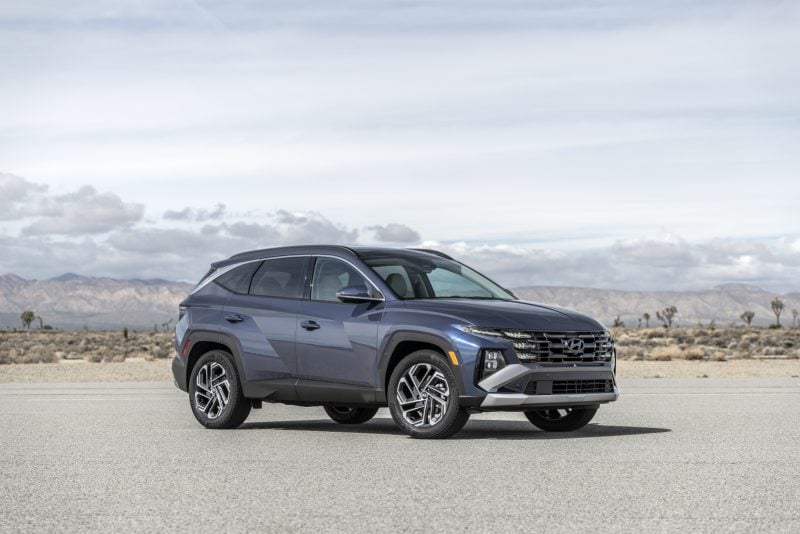
Shopping for a compact SUV in Ontario means making a real powertrain choice. The 2026 Mazda CX-5 arrives as a polished, third-generation model with refined technology and a proven gas-only lineup. The 2026 Hyundai Tucson counters with three distinct powertrains, including a hybrid and a plug-in hybrid, that the CX-5 cannot offer today.
That breadth is the Tucson’s defining advantage, and it shapes every comparison below.
2026 Tucson vs. 2026 CX-5: Key Specs at a Glance
| Feature | Tucson (2.5L Gas) | Tucson HEV | Tucson PHEV | CX-5 |
| Power (combined) | 187 hp / 178 lb-ft | 231 hp / 271 lb-ft | 268 hp / 271 lb-ft | 187 hp / 186 lb-ft |
| Fuel Economy (combined) | 8.8 L/100km | 6.7 L/100km | 3.1 Le/100km (electric) / 6.7 L/100km (gas+electric) | 9.0 L/100km |
| EV Range | - | - | 51 km | Not available |
| Drivetrain | AWD | AWD | AWD | AWD |
| Max Towing (with brakes) | 3,500 lbs (1,588 kg) | 2,000 lbs (907 kg) | 2,000 lbs (907 kg) | 1,500 lbs (680 kg) |
| Cargo (rear seats folded) | 2,119 L | 2,108 L | 1,876 L | 1,882 L |
| Built-in Navigation | Ultimate trim | Ultimate trim | Ultimate trim | Standard (GX and up) |
| Head-Up Display | Ultimate trim | Ultimate trim | Ultimate trim | GS and above |
Three Powertrains vs. One
The CX-5 runs a single 2.5L four-cylinder across all trims, rated at 187 hp and 186 lb-ft of torque, with a combined fuel economy of 9.0 L/100km. It is capable and well-sorted. But it is the only engine available.
The Tucson’s base 2.5L gas engine matches the CX-5 on horsepower and edges it on combined fuel economy at 8.8 L/100km. Step up to the 1.6L Turbo Hybrid and the gap widens: 231 hp combined, 271 lb-ft of torque, and a flat 6.7 L/100km city and highway. That is a 26% improvement over the CX-5’s combined rating.
On a 25,000 km annual driving schedule, the HEV saves meaningful fuel spend compared to either gas option in this comparison.
The PHEV raises the bar further. At 268 hp combined and 51 km of electric-only range, most Ontario commutes under 51 km run on electricity. When gas engages, combined consumption is 6.7 L/100km. The 13.8 kWh battery charges fully in about 2 hours on a 240V Level 2 connection.
Mazda has confirmed a CX-5 hybrid for 2027. For buyers choosing today, the Tucson is the only vehicle in this comparison with electrified options.
Cargo Space and Towing Capacity
The gas Tucson’s 2,119 L of maximum cargo space surpasses the CX-5’s 1,882 L, and the HEV’s 2,108 L stays competitive. Both Tucson variants give you noticeably more room for gear than the CX-5 with rear seats folded.
Towing is an even wider gap. The gas Tucson is rated at 3,500 lbs (1,588 kg) with trailer brakes; the CX-5 tops out at 1,500 lbs (680 kg). The Tucson’s hybrid models are rated at 2,000 lbs (907 kg) with brakes, still comfortably ahead. If you occasionally tow a small boat, utility trailer, or snowmobile, the Tucson is the practical choice.
One trade-off to note: the PHEV battery takes some space, dropping maximum cargo to 1,876 L. That puts the PHEV roughly on par with the CX-5’s 1,882 L. Buyers for whom maximum cargo is the priority should look at the gas or HEV Tucson.
Safety and Technology
Both vehicles deliver a robust standard safety suite. The Tucson includes forward collision avoidance with pedestrian, cyclist, and junction detection; lane keeping and following assist; blind-spot collision warning; rear cross-traffic avoidance assist; and adaptive cruise with stop-and-go on every trim. The top-tier Tucson adds features not available on any CX-5 trim: Highway Driving Assist 1, Blind View Monitor, Surround View Monitor, and Remote Smart Parking Assist.
On infotainment, the Tucson runs a 12.3-inch display across the lineup, with built-in navigation reserved for the Ultimate trim. The CX-5 takes a broader approach: Google built-in with Google Maps navigation is standard from the base GX, so navigation is available at a lower entry point. The CX-5 GX pairs that with a 12.9-inch screen, and the GT Premium Package steps up to 15.6 inches.
Both vehicles offer a head-up display. The Tucson’s HUD is standard on the Ultimate trim. The CX-5’s Active Driving Display, a windshield-projected colour HUD, is standard on the GS and above. Mazda notes this display is 122% larger than the outgoing model’s unit. Buyers who prioritize a HUD should confirm availability in their chosen trim on both vehicles, as each arrives at a different tier.
Which One Is Right for You?
The CX-5 is a capable compact SUV with a refined interior and a navigation story that starts at the base trim. For buyers who want a well-executed, gas-only option with standard Google Maps, it earns its place in the conversation.
But the Tucson covers more ground for more buyers. Gas commuters save at the pump over the CX-5. HEV buyers cut fuel consumption by over a quarter with no plugging required. PHEV buyers can run most of their weekly driving on electricity. And anyone pulling a trailer will find the gas Tucson’s 3,500 lbs (1,588 kg) rating far more practical than the CX-5’s 1,500 lbs (680 kg) ceiling.
For Ontario drivers who want efficiency options, real towing capacity, or electrified driving today, the Tucson’s lineup covers territory the CX-5 cannot reach until 2027.
The Right Tucson for Ontario Drivers
The 2026 Hyundai Tucson gives Ontario buyers three powertrain paths, more cargo volume in gas and hybrid trim, and a towing ceiling that more than doubles the CX-5’s rating. Buyers who want to reduce fuel costs, add an electric commute, or pull a trailer will find the Tucson’s range of options decisive.
Visit Cambridge Hyundai in Cambridge to explore the Tucson lineup and book a test drive in the powertrain that fits your daily routine.